In the world of digital marketing, cybersecurity, and sales intelligence, the Whois database has long been considered a “gold mine.” It contains the contact details of every registered domain owner on the planet—a direct line to millions of business owners, potential leads, and decision-makers.
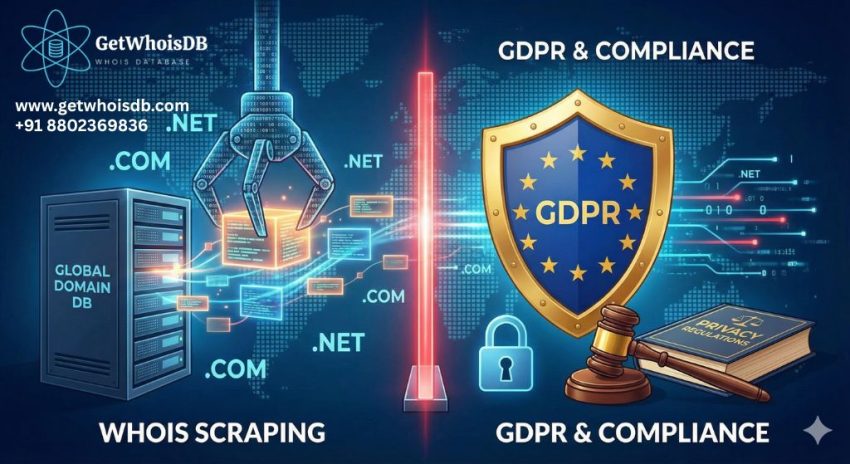
However, in 2026, accessing this mine is no longer as simple as writing a quick Python script. The introduction of strict privacy laws like the GDPR (General Data Protection Regulation) in Europe and the CCPA (California Consumer Privacy Act) in the US has turned this gold mine into a legal minefield.
For developers and marketers, the question is no longer just “How do I scrape this data?” but rather “Can I scrape this without getting sued or fined?”
This guide cuts through the legal jargon to explain the reality of scraping Whois data, the risks of non-compliance, and how to navigate the complex intersection of technology and privacy law.
What Is Whois Scraping?
Before diving into the laws, we must define the act itself. Whois scraping is the automated process of extracting registration data from the Whois protocol (often via Port 43) or web-based Whois lookup tools.
Traditionally, a Whois record provided a wealth of public information:
- Registrant Name (e.g., John Smith)
- Email Address (e.g., john.smith@gmail.com)
- Phone Number
- Physical Address
- Registration & Expiry Dates
Companies scrape this data to build “lead lists” for cold emailing, to monitor brand infringement (cybersecurity), or to resell the data as “newly registered domain” feeds. While the technology to do this is simple, the right to do it is what is currently being fought over in courts and parliaments.
The Big Disrupter: How GDPR Changed Whois Forever
If you are reading old forum posts from 2016 about how easy it is to scrape emails, ignore them. The world changed in May 2018.
When the GDPR came into effect, it fundamentally clashed with the original purpose of Whois. Whois was designed to be a public directory; GDPR mandates that “Personal Identifiable Information” (PII) cannot be published without explicit consent.
The “Temporary Specification” and Redaction
To avoid breaking EU law, ICANN (the organization that manages domain names) implemented a “Temporary Specification.” This forced registrars (like GoDaddy and Namecheap) to redact the personal contact info of users in the EEA (European Economic Area).
Today, if you scrape a standard Whois record, you will often see:
- Registrant Name: Redacted for Privacy
- Registrant Email: Select Request to Contact Owner (or a proxied email like
pw-38492@privacy-service.com)
The Legal Implication: Scraping the technical data (creation date, name servers, registrar name) is generally legal because it is not “personal data.” However, scraping the personal data (if it is exposed) of an EU citizen without their consent is a direct violation of GDPR Whois data rules.
Is It Illegal? The Short and Long Answers
Is scraping Whois data illegal?
- The Short Answer: Scraping public data is generally not criminal, but storing and processing personal data without permission can violate civil privacy laws.
- The Long Answer: It depends entirely on (1) Jurisdiction, (2) Intent, and (3) Method.
Let’s break down the three legal frameworks you must respect.
1. Privacy Law (GDPR & CCPA)
This is the biggest risk. Under GDPR, an email address (like firstname.lastname@company.com) is considered personal data. To process it (scrape and store it), you need a “Lawful Basis.”
- Consent: Did the user agree to be scraped? (Almost never).
- Legitimate Interest: Can you prove your business need outweighs their privacy rights?
- Cybersecurity: Yes, identifying a phishing site is usually a valid legitimate interest.
- Marketing: No, regulators rarely accept “I want to send them spam” as a legitimate interest that overrides privacy.
Risk: Fines under GDPR can reach up to €20 million or 4% of global revenue. While small scrapers rarely get hit with the maximum, “Cease and Desist” orders are common.
2. Contract Law (Terms of Service)
Almost every Whois lookup service or registrar has a Terms of Service (ToS) that explicitly forbids “automated queries” or “bulk scraping.”
- If you scrape GoDaddy’s Whois page, you are violating their ToS.
- While breaking a ToS isn’t a federal crime, it can lead to your IP being banned, your account being terminated, or a civil lawsuit for “Breach of Contract.”
3. The CFAA (Computer Fraud and Abuse Act) – USA
In the United States, the fear used to be that scraping was “hacking.” However, the landmark hiQ Labs v. LinkedIn case established a crucial precedent: Scraping public data is not hacking. The court ruled that accessing data that is publicly available (without a password login) does not violate the CFAA.+2
- Note: This protects you from criminal hacking charges in the US, but it does not protect you from privacy lawsuits (CCPA) or contract violations.
The “Legitimate Interest” Defense
If you are scraping for cybersecurity or brand protection, you are on safer legal ground than lead generation.
For Cybersecurity Researchers
Security companies scrape Whois data to detect “typosquatting” (fake domains like g0ogle.com) and malware command centers. Because this serves the public good (preventing fraud), it is easier to argue “Legitimate Interest” under GDPR. Many registrars even provide special “Tiered Access” to security professionals that reveals the redacted data.
For Marketers (Lead Generation)
This is the grayest of gray areas. If you scrape domain contacts to send cold emails:
- In the EU: This is highly risky. You are processing PII without consent for marketing.
- In the US: This is generally legal under CAN-SPAM, provided you follow the rules (include an unsubscribe link, don’t be deceptive). The US operates on an “Opt-Out” model, whereas the EU is “Opt-In.”
Pro Tip: If you are building a GDPR compliant lead generation tool, you should only target generic business emails (e.g., info@company.com) rather than personal ones (e.g., steve@company.com). Generic business emails often have fewer protections under GDPR.
Technical Compliance: Port 43 vs. RDAP
For years, scrapers relied on Port 43, a simple text-based protocol that dumped Whois data. However, Port 43 is being phased out in favor of RDAP (Registration Data Access Protocol).
Why RDAP Matters for Legality
RDAP is a standardized web-based JSON protocol. Unlike the “all or nothing” nature of Port 43, RDAP allows for Tiered Access.
- Public Tier: Shows only technical data and redacted fields.
- Authenticated Tier: Shows full data only to verified users (like law enforcement or IP lawyers).
If you are writing code for Whois scraping Python legal compliance, you should switch to parsing RDAP responses. It ensures you are accessing data through the modern, sanctioned channel rather than “hacking” old ports that registrars are trying to close.
5 Rules for Compliant Whois Scraping in 2026
If you decide to proceed with scraping, follow these strict guidelines to minimize your legal exposure.
1. Respect the robots.txt and Rate Limits
While robots.txt isn’t a law, ignoring it can be used as evidence of “malicious intent” in a lawsuit. Furthermore, aggressive scraping that crashes a server can be prosecuted as a DDoS attack. Always use rate limiting (delays between requests) to be a “polite” scraper.
2. Don’t Scrape “.EU” Domains for Leads
If your script encounters a domain ending in .eu, .de (Germany), or .uk (United Kingdom), skip it for marketing purposes. The privacy regulators in these regions are aggressive. Focus your lead gen efforts on .com or .io domains, which are more likely to be global or US-based entities.
3. Check for “Privacy Proxy” Services
If the registrant email is contact@privacyprotect.org, do not try to “unmask” or bypass this. The owner has taken explicit steps to hide their identity. Respecting this signal is crucial for demonstrating that you are not acting maliciously.
4. Sanitize Your Database
If you accidentally scrape PII from an EU citizen, delete it. Do not store “Redacted” data fields as if they are valid leads. Maintain a “Do Not Contact” list—if a domain owner asks to be removed, ensure they are scrubbed from your database forever.
5. Use Official APIs Instead of Scraping
The safest way to get Whois data protection laws on your side is to pay someone else to take the risk. Providers like WhoisXML API, DomainTools, or WhoisFreaks have legal teams that ensure their data collection methods are compliant.
- Why: When you buy data from them, you are buying a license to use it, and they bear the burden of collecting it legally.
Conclusion: Proceed with Caution
So, is scraping Whois data legal?
In 2026, the answer is: Yes, but with heavy restrictions.
You can legally scrape the existence of a domain, its creation date, and its technical nameservers. However, the days of easily scraping the personal home address and mobile number of a domain owner are over.
- If you are a security researcher: You have a strong case for access.
- If you are a marketer: You are walking a tightrope. Stick to US-based domains, respect privacy proxies, and consider buying “cleaned” data from reputable providers rather than running your own raw scrapers.
As privacy laws continue to evolve, the “wild west” of Whois is closing. The future belongs to those who respect data privacy, not those who try to bypass it.